 One vital thing that is always being interchange in video games is information. Either in a hardware level or in a psychological and social level information is being sent and received. This all starts when the user turns on the console and prepares themselves for an immersive experience. This is when animation becomes one very important key factor to making this possible. So today in dotBit we look closely to animation in general, animation in video games and the roles it plays.
Movement speaks volumes. This is fact even in the "real" world. If you see someone upset you would either approach and try and make that person feel better or just avoid the person all together because you might see it as a both a drag and waist of time. Body language is something we as humans cannot do without. Actors have made careers out of saying very little but projecting a whole bunch. It is how the famous saying goes: "A picture is worth a thousand words." Now knowing this information alone, how would you go about in applying this in a game?
Throughout my years of playing and studying video games and game design there has always been one keyword that is golden and it is immersion. You always wanna have the player stuck in your world. You want them to believe what they see and have them feel whatever it is they have to feel to keep them in that universe. So if you want to communicate something within the game world without breaking immersion then don't put an icon or floating text on it. When your outside walking do you see things pop-up in front of you prompting you where to go and what to do next?

Just over there.
This is where NPCs, Non-Player Characters, become very useful in video games. Your in the town called Gnir and your looking for the pub but don't know where it is you would go ahead and approach an NPC. Now through body language and tone of voice the NPC will interact with the player. This is why is why depth of a characters and NPCs are very important. Humans are not plain and simple so neither should NPCs. They need to evoke the same emotions and body language as a regular person would just to keep the immersion a live and running. So if the NPC hates or likes the player, don't give them statistics. Flaunt it! Either by the clothe the NPC wears, the type of tone of voice it projects and even the form it stands. This will help the player know if the NPC is submissive or arrogant, interested or impatient. It is also good to remember that all interaction is an exchange of status. Knowing who your friends and enemies are. Who to call for help and who to avoid at all cost.
Ever since computers were around the idea of AI, Artificial Intelligence, seems to capture the attention of engineers, especially yours truly right here. So it is evident how important AI is for NPCs. Yet it wouldn't be sold if it was not for animation. A game that executes this almost perfectly is Mass Effect. The people at Bioware knew the concept of immersion and the effectiveness of AI with animation can be. I remember playing and there was a plot twist in which I myself did find myself on the fence. So, I went ahead and asked their thoughts on the situation. Thus far I am already way immersed into the game because I am asking genuine help and feed back from the people who help me on my quest and make sure I don't get blown away from the mercenaries after me. As I approach them I notice by their face and tone that even though they did not know what was the correct decision they had my back no matter what! In part with that, this boosted my confidence in what my final decision would be.
 Watch what you say fool!
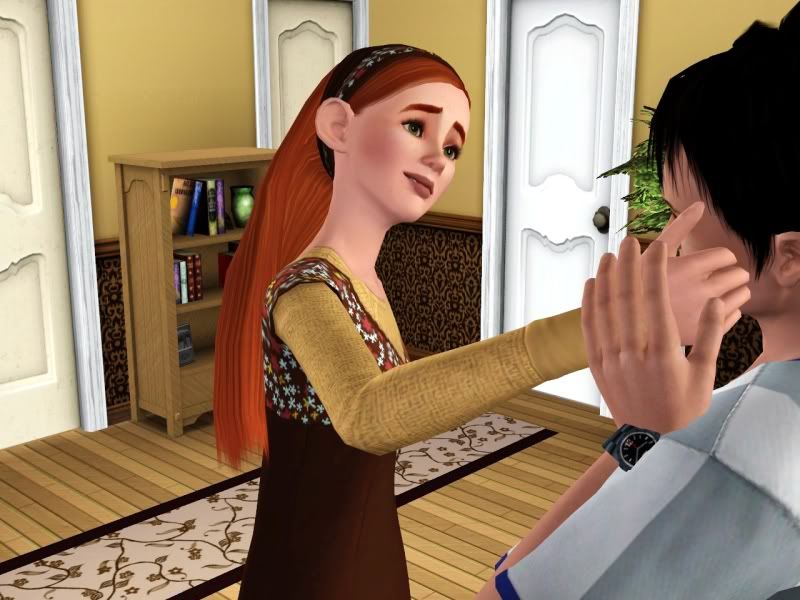 Awww!
Awww!Make note, animation can tell us about our characters, tell us who they are, tell us what they're thinking, delivering what may be crucial gameplay information. It can do these things without breaking the illusion of being in the game world. With body language and facial expression as our tools we can explore the subtle side of character interaction and reach beyond familiar themes.


 Posts
Posts


